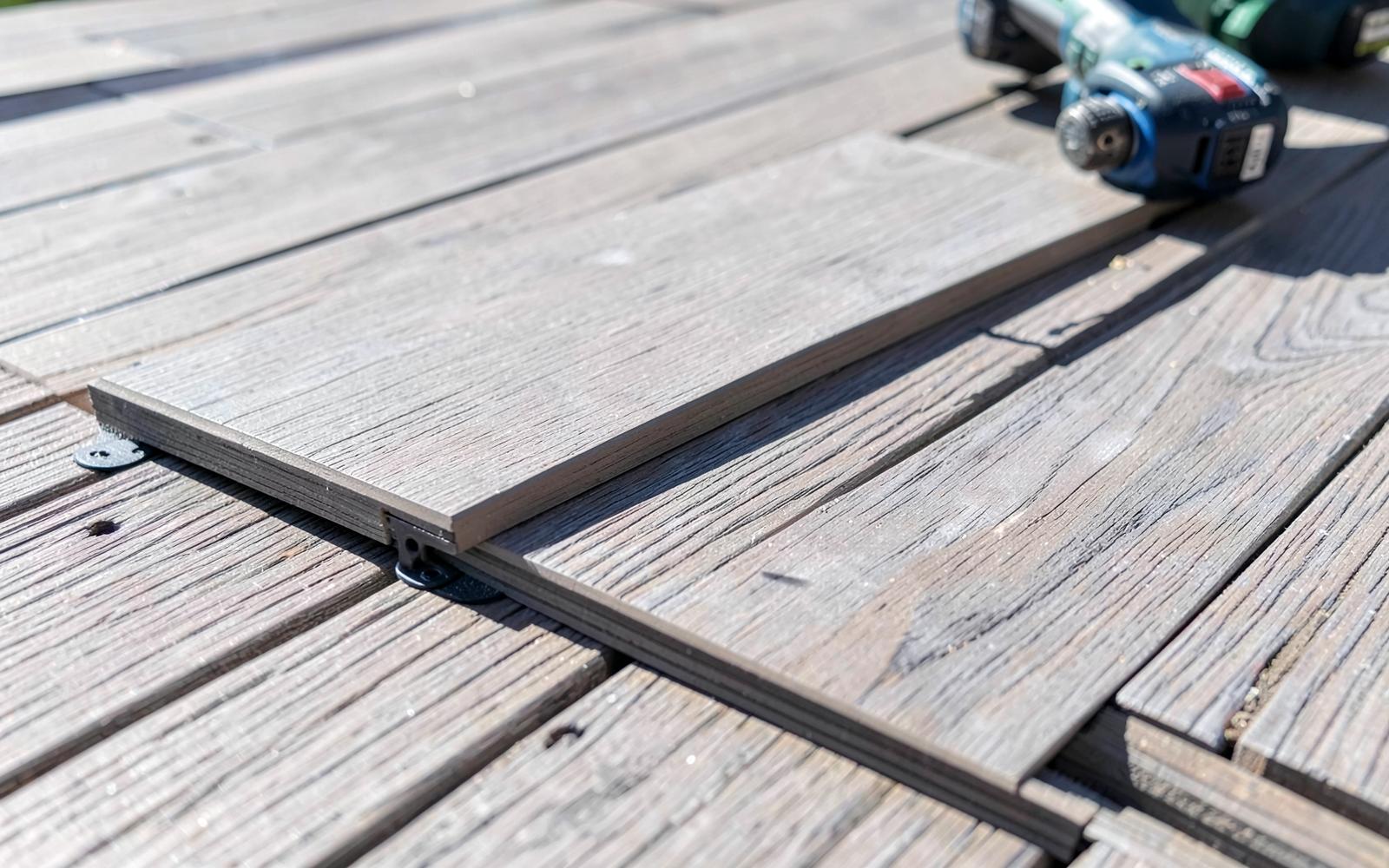
Composite Decking Installation in Colorado Springs
Composite deck installation in Colorado Springs is first a material decision — choosing a surface that can take high-altitude ultraviolet exposure and a winter of freeze-thaw cycling without breaking down.
Capped composite versus wood at 6,000 feet
Start with sunlight, because that is where the two materials separate fastest here. At 6,000 feet and above there is less atmosphere filtering ultraviolet radiation, so a stained wood deck loses its finish and starts greying and checking sooner than the same deck would at lower elevation. Capped composite puts a pigmented polymer shell over the core, and that cap is formulated with UV inhibitors specifically to slow fading. It is not immune — expect some lightening early on — but the change is gradual and even rather than blotchy.
Second is dimensional stability. Wood is hygroscopic: it takes on moisture from snowmelt and summer storms, swells, then dries and shrinks. Run that cycle through dozens of freeze-thaw swings in a single Colorado Springs winter and the result is familiar — surface cracking, cupped boards, raised grain, and screws that work their way proud. Composite absorbs very little water, so it sidesteps that failure mode entirely. It does move with temperature along its length, which is why end-gap spacing at installation is not optional.
Third is heat. Composite runs warmer than wood under direct summer sun, and a dark board on an unshaded west-facing deck can be uncomfortable barefoot in the middle of a July afternoon. That is a real tradeoff, and it is managed with color choice and shade rather than ignored.
Fourth is upkeep. Wood wants cleaning and re-staining or re-sealing on a regular cycle, and at this elevation that cycle comes around faster than most homeowners expect. Composite generally asks for soap, water, and a brush. Where wood still makes sense: a tighter budget, a smaller deck where refinishing is a short afternoon, or a homeowner who specifically wants the look and smell of real cedar or redwood and accepts the maintenance that comes with it.

When composite makes sense
Composite is usually the stronger choice on south- and west-facing decks, where sun exposure is heaviest and a wood finish will not last long between refinishes. It also suits homeowners who would rather not commit a weekend every year or two to sanding and staining — low maintenance decking in Colorado is less a luxury than a way to keep a deck looking intentional after five winters.
High-traffic decks make a good case too. Surfaces that take furniture dragging, grill spatter, dog claws, and constant foot traffic hold up better with a capped surface than with softwood, and stains lift off the cap instead of soaking into open grain. Where the deck is small, shaded, or built to a tight budget, wood remains perfectly reasonable.
Related: deck builders in Colorado Springs, custom deck design and construction, and deck railings and stairs.
Frequently asked questions
How does composite decking hold up to Colorado's UV exposure?
- Capped composite carries a fused polymer shell with UV inhibitors and pigment engineered into it, so it fades far more slowly and far more evenly than a stained wood surface at this elevation. Most quality capped products still lighten slightly over the first year or two and then stabilize. Uncapped or older-generation composite does not hold color nearly as well under high-altitude sun, which is why the cap matters more here than it would in a cloudier, lower market.
Does composite decking get too hot in direct sun at altitude?
- Composite does run warmer than wood in direct summer sun, and that is worth planning for on a south- or west-facing deck. Color is the biggest lever — light greys and tans absorb noticeably less heat than dark browns and near-blacks. Shade from a pergola, an awning, or existing tree canopy also makes a real difference, and most people find early morning and evening use unaffected either way.
How does composite handle freeze-thaw cycling compared to wood?
- Composite absorbs very little moisture, so it does not swell, cup, split, or check the way wood does when water works into the grain and then freezes. It does expand and contract lengthwise with temperature, which is handled through correct end-gap spacing at installation. Wood, by contrast, takes moisture in through the season and the repeated freeze-thaw cycles here are what produce cracking, raised grain, and popped fasteners over time.
What composite brands or types do you install?
- We work with capped composite and capped polymer boards from the major decking manufacturers rather than tying every project to one product line. The practical selection criteria are the quality of the cap, the fade and stain warranty the manufacturer publishes, board color and surface temperature, and whether the profile supports hidden fasteners. We can also install uncapped composite or wood where budget or aesthetics point that direction.
Get a composite decking quote
Tell us about your deck's exposure and size and we'll follow up to talk through board options.
Call (719) 800-9186Request a quote
Tell us about the deck you have in mind and we'll be in touch.